
LECTORAAT CHANGE MANAGEMENT – De Haagse Hogeschool
Cycling on the side walk | Teaching a critical thinking course: frames & observations more than a year after Japanonderzoek op het randje
After more than 20 years of teaching experience in the Netherlands, mostly at International Business at The Hague University of Applied Sciences, I went on a staff mobility pilot teaching and doing research for a semester at Yamagata University in Japan in Spring 2023. Bringing my family along.
Blog 2.5: Returning to Japan by watching Film
This nervous itch is not going away – that feeling in my stomach that I am not done with Japan. I have wanted to write my third blog on teaching critical thinking at Yamagata Daigaku in Japan for almost a year now. Of course there are always many more plans than executions, and quite a few of my plans take the back seat or slowly dissipate. This plan has not.
I miss cycling on the sidewalk of Yamagata to the university. It’s been over a year now since I returned to the Netherlands and have picked up my cycling to the station again and taking the train to work at The Hague University of Applied Sciences.
We (my husband and I) wanted to hold on to the slower rhythm of Yamagata where people are not pushy in traffic but accept their place in the line up of cars and waiting lines for trains. Our daughters’ schools still communicate with printed sheets of paper instead of endless What’s App and Parro messages. But back in The Netherlands the local pace is hard to beat and before you know it a year has passed where I have not been able to create time to reflect on Japan, and my critical thinking teaching with film course there for my planned final blog 3.
But hiding now in my aunt and uncle’s cottage in a quiet holiday park somewhere ‘remote’ in the North of Holland I am trying to get back to that slower pace of Yamagata, and scratch that nervous itch. What is there for me to still learn and uncover?
Film is my go to mode, and to get embedded and pulled back into Japan I start with watching (for the first time) Tokyo Story (1953) and rewatching Departures (2008).
Tokyo Story is director Yasujirō Ozu’s most famous film, critically acclaimed to be one of the best films ever. It relates the story of an older couple who live in the country and visit their grown-up children who have ‘made it’ in the big city of Tokyo but hardly take the time to show their parents around.
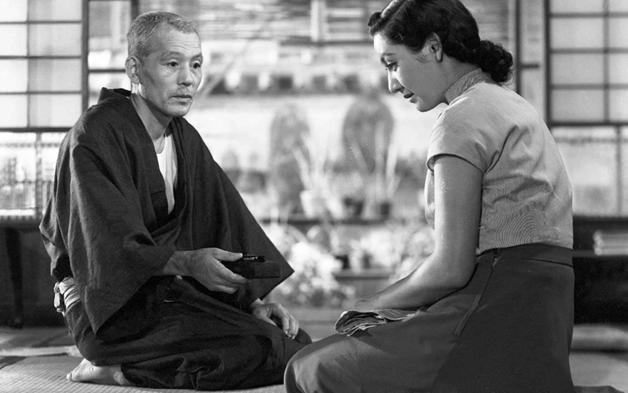
For me to return to a slower and meaningful pace, this movie is great. Ozu, I read and experience, is a master of slow pace, and crafting his narrative without me getting bored or distracted. What is refreshing is that the camera is at a low angle and does not move (only once according to film critic Roger Ebert, which supposedly is a lot for Ozu), very clearly showing off the beautiful frames of the Japanese interiors at that time. It is those black and white frames that appeal to me, the lines and sliding doors.
In our critical thinking courses we teach our students that ‘everything is framed’ and Ozu’s shots create such beautiful frames that capture my attention. There is something peaceful in people sitting close to the ground on their knees (even though this has been researched to be a very bad posture and is not allowed to be enforced anymore in Japan), eating at low tables with chopsticks, taking shoes off and on and opening and closing sliding doors.
The film is shot at a set of locations, mainly inside the houses of the parents and the children, and the repetition of the camera angle and frames is both pleasing and reassuring as you have seen it before. This helps to focus on the movements of the characters and the dialogue taking place, and because of that as a viewer to see more. The director helps you to critically think about what is taking place, and read between the lines.
The mise-en-scene of Tokyo Story reminds me of an exhibition I recently saw about exteriors of houses in Japan at Huis Marseille. Photographer Awoiska van der Molen made photos of windows, with similar frames, only then from the outside:
Her process of making these photos helped me to see more:
‘Van der Molen encounters these windows while traveling through Japan in a regio where houses are constructed using traditional methods and materials. The walls are thin due to the mild climate. She is struck by the fact that apart from the din of a television, the soft shuffle of socks on echoing floors, or the clatter from a kitchen, she only hears the monotonous hum of air con. No heated discussions, no loud laughter, n o sensual sighs. <….> As she silently traverses the darkness, Awoiska van der Molen captures the hushed world behind and around the windows. Her photographs demand slowness. Slowness during the creation of the image. Slowness in its materialisation. Slowness in viewing the results.’
This brings me back to my Japanese classroom, even though the interiors and exteriors of the Yamagata University are really not that pretty as the pictures above. They are actually a lot more similar to the classrooms of The Hague University
Still the frame in which I was used to teaching critical thinking with film in The Netherlands was different: it forced me to slow down. One thing was the language aspect as English was more difficult to follow for my Japanese students, as well as my more dialogical approach to teaching which was unfamiliar. See my blog 1 and blog 2 for more about this. This was at times frustrating.
But the slowness that I appreciate was having time to teach the students for one whole semester. To have time to repeat the frames of the 90 minute lesson for 16 weeks to build up the course’s story every week. I had my own quiet office and enough time to prepare my classes each week, to alter it to the needs of my Japanese students. There was repetition of the same people, and I did not have to wonder who would show up, the actors were all present – the teacher and the students – which helped with building up the scenes to the closing act.
And similarly to what Awoiska van der Molen experienced outside Japanese houses, in the interior of my Japanese classroom there were no heated discussions. But this did not mean that critical thinking was not taking place. The slowness, attentive actors, and repetition of frames like Tokyo Story, created space for meaningful conversations about critical thinking: in the film scenes we watched, discussed and the films scenes we created.
Now, more than a year later, finally giving space to address my itch, I have taken myself to a house with thin walls – and with the help of movies and non-disturb time write this blog and start reflecting again on my critical thinking teaching adventure in Japan. More to follow in my ‘future’ Blog 3 as I made a film together with my Japanese students on their quick automatic and slow logical thinking during the day.
But I would already like to invite you to Fragments Symposium we are organizing on Friday November 29 at Filmhuis Den Haag: stimulating critical thinking using film – see https://www.flickthink.org/fragments. As I am not done with Japan I will give a workshop about my experience there, showing film clips instead of describing them (more on Departures then as well), and continuing the dialogue with you.

 LECTORAAT CHANGE MANAGEMENT - De Haagse Hogeschool